Latest News
Nigeria Records 20% Rise in Palm Oil Exports in Q3 2025

In a surprising turn of events, Nigeria has seen its palm oil exports surge by 20% in the third quarter (Q3) of 2025. This jump marks an important milestone for the country’s non-oil sector and promises potential for rural economies, agricultural firms, and national revenues alike.
Though exact numbers are still being verified by the Nigerian Export Promotion Council (NEPC) and the National Bureau of Statistics (NBS), initial data and industry reports strongly indicate that Nigeria is gradually reclaiming ground in the global palm oil trade—once dominated by Southeast Asian producers.
This article examines what is driving this growth, how Nigeria is managing production and challenges, and what this means for farmers, exporters, and consumers.
What the Numbers Say
- 20% export growth: Q3 exports of crude palm oil and its refined fractions rose by around 20% compared to Q3 of the previous year.
- Non-oil export uptrend: Nigeria has been witnessing a broader increase in non-oil exports. In the first half of 2025, non-oil exports rose nearly 19.6%, reaching about US$3.225 billion, compared to the same period in 2024. (Muslim Network)
- Profit projections: Two of Nigeria’s leading palm oil companies — Presco Plc and Okomu Oil Palm Plc — are projected to report a combined after-tax profit of about ₦161 billion (approx. US$105 million) in 2025. (Milling Middle East & Africa)
- Domestic price shifts: Palm oil prices within Nigeria have been rising sharply, in part due to global demand, currency devaluation, and import input inflation. For example, local crude palm oil price in 2024 rose about 56.8% year-on-year. (Businessday NG)
Why Now? Key Drivers of the Export Rise
Several factors underlie the 20% rise in palm oil exports in Q3 2025. Some are internal (Nigeria-specific), others are global.
- Global demand and supply tightness
- Southeast Asia (Malaysia, Indonesia) is seeing increasing domestic mandates (especially for biodiesel) which reduce exportable surpluses. This puts upward pressure on global prices. (Reuters)
- With supply tightening elsewhere, buyers are looking to alternative markets. Nigeria is emerging as one such market.
- Favourable pricing
- Forecasts by Afrinvest predict that crude palm oil (CPO) prices might hit US$1,200/metric tonne by late 2025, up from roughly US$900/metric tonne earlier. (Milling Middle East & Africa)
- The stronger price environment makes export more profitable and incentivises producers to scale operations.
- Government policy & traceability initiatives
- Nigeria has launched a National Palm Oil Traceability System (NaPOTS) to improve quality, ensure compliance with international standards (especially for buyers sensitive to sustainability and deforestation concerns), and reduce loss or fraud in the value chain. (Nairametrics)
- Efforts to reform export regulation, reduce bottlenecks, and improve infrastructure are helping too.
- Local production gains and investment
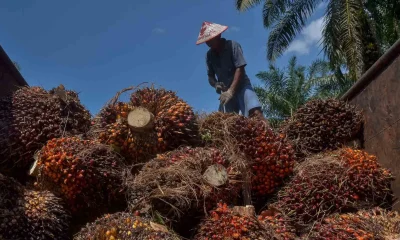
- Although Nigeria’s average yield remains relatively low compared to top producers, there have been incremental improvements. According to data from the USDA/FAS, Nigeria cultivates about 3,200 thousand hectares for oil palm, producing around 1,500 thousand metric tons with yields of ~0.47 tonnes/ha. (IPAD)
- Key palm oil firms are boosting production capacity, streamlining operations, and improving processing/marketing.
- Currency and import substitution effects
- The depreciation of the naira increases export competitiveness (in foreign currency terms).
- High import costs for edible oils encourage exporters to fill demand gaps in neighbouring countries, increasing export flows regionally.
Real-Life Examples / Case Studies
To understand how this plays out on the ground, consider the following:
- Okomu Oil Palm Plc
One of the most visible players in the oil palm sector. Okomu has been progressive in replanting aging plantations, improving yields, and investing in sustainability. Its revenues have grown substantially in recent years, and the firm benefits from both export demand and local demand. (Businessday NG) - Presco Plc
Operating in the southeastern region of Nigeria, Presco has also benefited from rising global prices and improved efficiency. The combined fortunes of these two companies are central to understanding Nigeria’s upswing in palm oil profitability. (Businessday NG) - Smallholder farmers
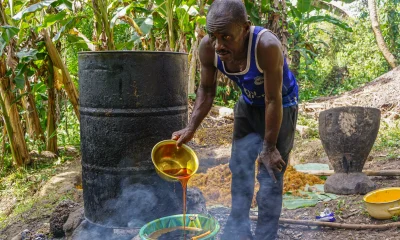
Many small-scale farmers in states like Akwa Ibom, Edo, Delta, Ondo and Cross River are reporting improved incomes. Some of this is due to better yields (through improved seedlings, training, better fertilisers) and better access to export markets via aggregation by cooperatives or traders. While precise data is scarce, anecdotal reports suggest that where infrastructure (roads, access to mills) has improved, farmers are doing well. - Export markets expanding
Nigerian exporters are increasingly finding buyers beyond traditional neighbours. While shipments historically have gone to nearby West African nations, there’s growing interest from buyers in Asia and Europe, especially for refined or fractionated palm oil that meets quality, sustainability, and traceability criteria.
Challenges & Risks
Despite the strong growth, Nigeria still faces important challenges that could limit or threaten sustainability of this rise.
- Quality and standards:-Export buyers, especially in Europe and some Asian nations, require strict compliance with sustainability, environmental, and labour standards. Deforestation, traceability, chemical residue, and land rights issues can become barriers.
- Infrastructure:- Poor roads, unreliable energy supply, inefficient milling and processing facilities hamper productivity. Transportation cost from farms to ports remains high and unpredictable.
- Financing & input costs:- Many farmers struggle to get affordable loans, high-quality seedlings, fertilisers, and machinery. Currency devaluation also increases the cost of imported inputs.
- Land tenure and conflicts:- Land ownership disputes, unclear rights over forest land, and local conflicts sometimes slow down plantation expansion or lead to legal risk.
- Weather / environmental risk:- Nigeria, like many other countries, is exposed to climate risks—droughts, flooding, pests, and diseases. Changes in rainfall patterns can affect yield. Also, over-exploitation without sustainable practices could degrade soil and reduce long-term productivity.
- Global policy risk
Changes in trade policy, import tariffs, or environmental regulations abroad could affect demand. For instance, the European Union’s anti-deforestation laws or stricter restrictions on palm oil linked to land-use change might reduce market access for non-compliant producers.
Implications
What does this 20% rise in exports mean for various stakeholders?
- For the Nigerian economy:- Boosting palm oil exports helps diversify away from crude oil, which remains volatile. Increased export revenues can strengthen foreign exchange inflows, help stabilise the naira, and support macroeconomic resilience.
- For rural communities / small farmers:- If growth is inclusive, more smallholders will get access to better inputs, training, and pay for their produce. This could reduce poverty in oil palm growing regions.
- For companies and investors:- Exporters who have adopted sustainable practices, quality control, and traceability are well-positioned to benefit. There may be increasing investment opportunities in processing, refining, packaging, and value-addition, not just raw export.
- For consumers:- There could be trade-offs. Export growth might mean higher domestic prices (as supply is partly shifted to foreign buyers). Also, increased focus on export quality could improve local supply quality in some cases.
- For the environment:- The hope (and challenge) is that growth will be accompanied by sustainable land use, replanting, proper agroforestry, protection of forest areas, and respect for environmental laws. If not managed well, expansion could lead to deforestation, biodiversity loss or soil degradation.
Comparisons to Other Producers
To put Nigeria’s rise in context, we need to compare with dominant global producers:
- Indonesia and Malaysia remain the top producers by a large margin. Combined, they account for the vast majority of global crude palm oil exports. (Foreign Agricultural Service)
- Nigeria’s production is modest in comparison, but increasing: According to USDA / FAS, Nigeria’s oil palm production is about 1,500 thousand metric tons on ~3,200 thousand hectares. (IPAD)
- Yields in Southeast Asia are generally higher due to longer established plantations, more mechanisation, better inputs, and favourable climate. Nigeria has room to improve yields via research (for example, work by NIFOR — Nigeria Institute for Oil Palm Research) and technology. (Wikipedia)
What Needs to Be Done to Sustain Growth
The recent growth is promising, but sustaining or increasing export growth will require several interventions.
- Strengthening traceability and sustainability standards
- Ensuring compliance with international norms on deforestation, labour and environment.
- Widespread implementation of systems like NaPOTS must be transparent, enforceable, and trusted by buyers.
- Agricultural research and improved inputs
- More investment in high-yield, disease-resistant seedlings.
- Fertilisers, pest control, extension services must reach small farmers.
- Research institutes like NIFOR playing a role in breeding and best practice dissemination. (Wikipedia)
- Better infrastructure
- Rural road networks, storage facilities, reliable electricity.
- Improved ports and export facilities to reduce delays and spoilage.
- Access to finance
- Subsidies, credit lines, or public–private partnerships could reduce the cost burden on farmers and processors.
- De-risking by governments or donor agencies may encourage private investment.
- Policy consistency and support
- Stable agricultural policy, land rights, export regulation.
- Clear incentives for value addition (refining, fractionation, packaging) not just raw exports.
- Environmental safeguards
- Enforce laws against illegal land clearing.
- Promote agroforestry, intercropping, soil conservation.
- Monitor climate risks.
Possible Scenarios Going Forward
Considering the forces at work, here are a few plausible scenarios for the rest of 2025 and beyond:
| Scenario | Description | Likely Outcome / Risk |
|---|---|---|
| Optimistic | Continued global demand, stable prices, effective policy reinforcement, and production improvements. | Nigeria might see export growth of 25-30% year-on-year in coming quarters. Value-addition could expand; small farmers benefit; foreign exchange inflows rise. |
| Moderate | Price volatility, some export hurdles, modest production increases. | Growth continues but at a slower pace (10-15%). Some exporters may struggle with quality or shipping delays. Domestic prices rise, possibly reducing supply for export. |
| Pessimistic | Adverse climate, failure to meet export standards, international trade restrictions, or domestic problems (e.g. insecurity, policy reversals). | Growth stalls or reverses. Nigeria may lose buyers to more consistent suppliers. Smaller operators may be squeezed out. Export revenues may fluctuate heavily. |
Conclusion
Nigeria’s 20% rise in palm oil exports in Q3 2025 is a sign that the country may be turning a corner in its agricultural export strategy. The combined forces of global demand, favorable prices, and policy reforms are pushing Nigeria’s palm oil industry forward.
However, sustaining this momentum will require deliberate effort: improved standards, better investment in infrastructure, strong support for small farmers, and attention to environmental sustainability. If managed well, this export growth can bring real benefits — not just for large firms, but for rural communities, for the national economy, and for lasting socioeconomic development.
In short, Nigeria has a chance to transform its palm oil sector from exporter of raw produce into a powerhouse of value addition, sustainability, and inclusive growth. The next few quarters will tell whether this 20% jump is a one-off bump or the start of a sustained ascent.