Featured
Nigeria @ 65: Palm Oil as the Forgotten Gold of Independence
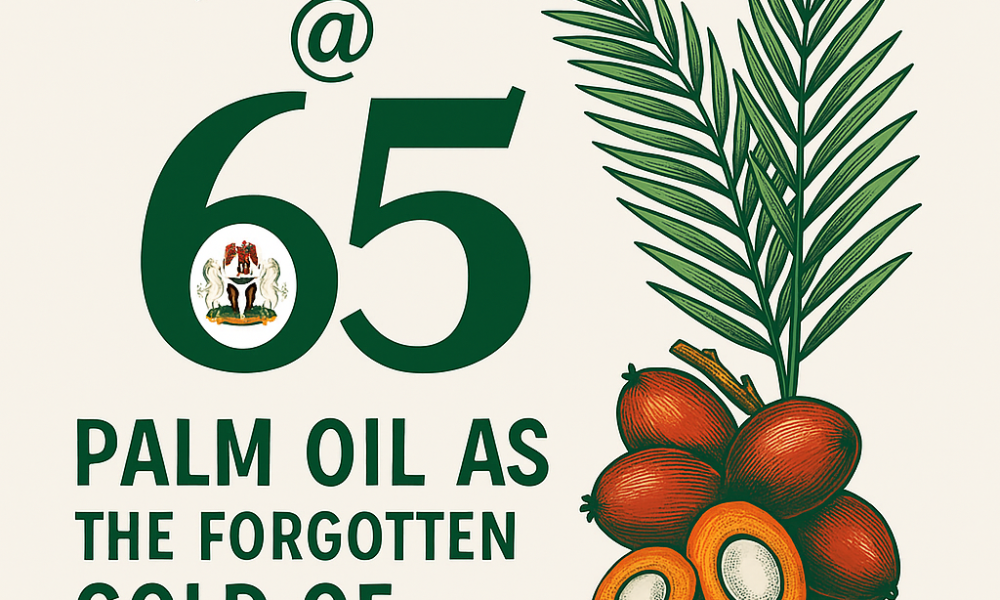
When Nigeria gained independence in 1960, it had vast agricultural potential. Palm oil was one of its crown jewels: both a domestic staple and a major export. Over the decades, however, palm oil has slipped from its position of prominence. As Nigeria marks 65 years of nationhood, it is time to revisit this “forgotten gold”—to trace how palm oil shaped our past, where it stands today, what has gone wrong, and how we can reclaim its promise for economic independence and sustainable growth.
Historical Background & Timeline
Here is a timeline tracing Nigeria’s palm oil industry—from pre-colonial times to independence, through its highs and decline, and into recent revival efforts.
| Period | Key Events & Developments |
|---|---|
| Pre-Colonial / Early Colonial (mid-1800s to early 1900s) | Palm oil and palm kernel were part of local economies long before European contact. Local communities used the oil for cooking, lighting, soap, etc. With the arrival of European traders and colonial administration, palm oil became a commodity for export: soap, industrial lubricants, etc. British colonial policy encouraged palm oil trade. By 1840, exports of palm oil from what is now Nigeria were already significant. (Wikipedia) |
| 1930s-1950s | Growth in plantation and wild grove exploitation. Colonial government introduced more efficient processing technologies and some plantation schemes. By the early 1950s, Nigeria’s palm oil exports had grown substantially. Statistics from 1931 to 1954 show palm oil output increasing steadily: e.g. ~118,133 metric tons in 1931, ~216,587 metric tons by 1954. (Konfrontasi) |
| 1960 (Independence) to mid-1960s | Nigeria was then a global leader. At independence, Nigeria produced around 43% of the world’s palm oil, making it the biggest producer of crude palm oil globally. Domestically, palm oil was central to diets, livelihoods, and foreign exchange earnings. (agriculturenigeria.com) |
| 1966-1970 (Civil War period) | The Nigerian Civil War (Biafran War) caused severe disruption. Many of the commercial palm‐belt areas were in the East, which was heavily impacted. Estates, groves, and processing infrastructure were damaged; production dropped. (World Bank) |
| 1970s-1980s | Partial recovery post-war. By the mid-1970s, peak post-war production had improved, though not returned to all pre-war levels. For example, production of palm oil was about 510,000 metric tons in 1976 (post-war peak) vs ~574-580,000 MT around 1965-66. (World Bank) Also many estates and smallholder operations expanded. Growth continued into 1980s. (Konfrontasi) |
| 1990s-2000s | Decline in relative global share. Nigeria’s production stagnated. Many plantations were neglected, yield per hectare dropped. Domestic demand grew, but production could not keep up. Imports of crude palm oil increased. Little policy consistency. (agriculturenigeria.com) |
| 2010-2020 | Some revival and renewed policy interest. Production gradually increasing. However, still far below what is needed to meet domestic consumption. In 2017-2020, the domestic production was around 1.3-1.5 million metric tons; demand higher. Public and private actors begin emphasizing value‐addition, replanting, and revitalization of old estates. (Statista) |
| 2023-2025 | Renewed energy in the sector. Key companies (Okomu, Presco) posting strong profits. Government launching frameworks (e.g. National Palm Oil Traceability System), aiming to close production‐consumption gap. Recent data suggests production of ~1.4 million metric tons; consumption ~1.9-2.0 million MT. Imports have slumped recently but still needed to fill a shortfall. (Statista) |
The Golden Age: What Nigeria Once Was
To appreciate how far we’ve shifted, some more detail on Nigeria’s past strength in palm oil:
- Global dominance pre‐1960s: Nigeria was the world’s largest producer. In 1961, for example, out of about 1.479 million tonnes of crude palm oil produced globally, Nigeria produced ~669,000 tonnes, nearly half of global output, and over 50% of Africa’s share. (Businessday NG)
- Supporting industries and infrastructure: Palm kernel, kernel oil, oil mills, plantations (commercial estates), and wild grove harvesting all contributed. Many people—farmers, rural laborers—were employed. Infrastructure (mills, transport) and colonial investment supported export to Europe. Research institutes (like in the 1950s) were focused on improving seed varieties, processing. (Konfrontasi)
- Export & foreign exchange: Palm oil exports brought in foreign currency, used for national development—roads, schools, industry. Not all estates were large, but combined they gave Nigeria comparative advantage in trade in “legitimate crops” (i.e. non‐oil) besides petroleum. (Konfrontasi)
What Happened: Decline and Missed Opportunities
Despite that strong start, palm oil’s rise stalled. Several interlocking reasons:
- Neglect of estates & ageing plantations:- Many of the large plantations declined because of lack of maintenance, poor replanting, and ageing oil palm trees. Palm trees have economic productive life spans (25-30 years) after which yield drops. Nigeria still has many old groves with low productivity. (Businessday NG)
- Shift to Oil (Petroleum) Economy:- The discovery of oil and vast revenues from crude petroleum from the late 1960s into the 1970s shifted government attention and investment away from agriculture. Palm oil became less of a focus in policy compared to oil and gas. Resources, manpower, subsidies moved to oil sector. This also affected rural infrastructure that supported palm belt regions. (Businessday NG)
- Civil War and Political Instability:- The Civil War (1967-70) much disrupted the palm belt areas (Eastern/Niger regions), damaging groves, disrupting labour, destroying processing facilities. Post-war recovery was slow. In later decades, political instability and inconsistent agricultural policy also hampered growth. (World Bank)
- Low yield & smallholder dominance:-Smallholders dominate production (over 80%) but often with low technical know-how, lack of access to good seedlings, limited mechanisation, poor farm inputs, poor extension services. Wild groves continue to contribute a large share—these are less controlled, lower yield per hectare. (Food Business Africa)
- Infrastructure problems;-Poor road networks, electricity, processing mills. Many plantations are remote and transport of fresh fruit bunches (FFBs) in poor condition leads to losses. Mills are often inefficient, old, or under‐utilized. (Businessday NG)
- Policy inconsistency & weak incentives: Agricultural policies have sometimes been short‐term, not well funded, or shifted between regimes. Issues such as land tenure (who owns the land, how smallholders can lease, certification) cause uncertainty. Import duties, subsidies, tax breaks often inconsistent. Trade policies sometimes favour cheap imported palm oil or allow smuggling. (Food Business Africa)
- Global competition:-Malaysia, Indonesia have invested heavily, expanded large plantations, improved yields, developed strong processing, refining, and export chains. Also pushed into biodiesel and downstream industries. Nigeria lagged behind in competitiveness. (National Economy)
- Environmental & social issues:- Deforestation, land disputes, labour issues, pests & diseases, poor seed quality, climate effects all contributed to inefficiencies. Also, some wild groves got fragmented, degraded. (Businessday NG)
Where We Are Now: Recent Data & Developments
As we approach Nigeria’s 65th Independence anniversary, here is a snapshot of the current status:
- Production vs Demand
- Nigeria produces around 1.4 million metric tons of palm oil (crude) as of 2023. (Statista)
- Domestic consumption is higher: about 1.9-2.0 million metric tons for recent crop years. (Statista)
- The gap (shortfall) is often in the range of 450,000 MT or more, which Nigeria currently fills via imports. (The Point)
Imports
-
- Despite efforts to boost local production, Nigeria remains a net importer of crude palm oil. (The Point)
- Recently, imports have decreased—some months saw a slump of ~77% compared to earlier periods (March to June 2025) in import value, partly due to rising domestic production and global prices. (New Telegraph)
- Profitability & Key Players
- Two major listed companies, Okomu Oil Palm Plc and Presco Plc, are showing strong profits. For 2025, they are projected to post combined after-tax profits of around N161 billion, driven by rising global crude palm oil (CPO) prices, improved operational efficiencies, and favourable market conditions. (AgriInsite)
- Presco’s revenue, local sales, export sales have been growing strongly; Okomu similarly has seen revenue growth, cost pressures notwithstanding. (Businessday NG)
- Policy / Institutional Moves
- The Federal Government has launched the National Palm Oil Traceability System (NaPOTS) framework and set up an inter-agency committee (16 members) to oversee quality, sustainability, and market competitiveness. (Nairametrics)
- Oil Palm Growers’ Association of Nigeria (OPGAN) has proposed a 5-year Oil Palm Development Strategy aimed at replanting 1.5 million hectares across 27 oil palm–growing states by 2029; increasing output, increasing tax and revenue, supporting smallholders. (Businessday NG)
- Constraints still present
- Many trees are old and past prime production years, leading to low yields. (Businessday NG)
- Land tenure, access to finance, seedling quality, processing capacity, infrastructure deficits remain major bottlenecks. (Businessday NG)
Why Palm Oil Matters Now (at 65)
Given this history and current data, why should Nigeria focus now on palm oil?
- Economic Diversification and Reducing Oil Dependence:- Nigeria’s economy has been heavily reliant on oil & gas. Fluctuating global oil prices make that risky. Palm oil offers a way to diversify into agriculture, agro-processing, value addition, employment, especially in rural areas.
- Employment & Rural Development:- Palm oil cultivation and processing employ millions—smallholders, plantation workers, transporters, processors. Reviving the industry can reduce rural poverty, slow urban migration, improve livelihoods across palm belt states (Cross River, Edo, Ondo, Rivers etc.).
- Food security and domestic needs:- Palm oil is a staple cooking oil in many Nigerian homes; also used in food processing, soaps, cosmetics, livestock feed. Ensuring stable local supply helps reduce import bills, stabilizes price volatility, and improves food security for lower income households.
- Foreign Exchange Savings & Earnings:- Importing palm oil costs Nigeria significant foreign currency. By producing more domestically, Nigeria can save on import bills. Also, if production and processing are scaled well, could export value-added palm oil products.
- Global Demand Trends:- Worldwide demand for vegetable oils (including palm oil) is rising, driven by increasing population, rising incomes, and uses beyond cooking (biofuels, cosmetics, industrial oils). Nigeria can tap into export markets if quality, traceability, and compliance improve. (National Economy)
- Environmental / Sustainable Agriculture Opportunities:- With modern practices—traceability, certification, sustainable land use, agroforestry, climate smart agriculture—palm oil production can be made more sustainable, less damaging, more resilient to climate change. Reviving old groves and replanting gives opportunities to improve yield with less land expansion.
Challenges / Barriers
While the opportunity is real, several challenges must be addressed. Some are legacy issues; others are current gaps.
| Challenge | Specifics | Why It Matters |
|---|---|---|
| Old/declining trees | Many plantations have trees past 25-30 years, low yields; often harvesting from wild groves whose productivity is unpredictable. (Businessday NG) | Low yield per hectare means more land needed; higher costs; harder to compete with high-yield producers like Malaysia/Indonesia. |
| Seedling quality & R&D | Lack of high-yield, disease resistant seedlings; smallholders often lack access; inadequate extension support. | Better seed varieties can greatly improve productivity. Without R&D and extension, smallholders cannot scale well. |
| Land tenure / access issues | Unclear ownership, disputes, lease rights; smallholders sometimes lack secure land rights; conversion of land sometimes controversial. | Investor hesitation; poor access to long-term financing; conflict with communities or environmental laws. |
| Infrastructure deficits | Bad roads, cold chain / transport issues for fresh fruit bunches, power supply issues for mills; mills themselves may be small/inefficient. | Loss of produce, higher input/operational costs, reduced competitiveness. |
| Finance & Capital Access | High cost of credit; smallholders often lack collateral; commercialization of estates requires large capital; processing and refining require investment. | Without finance, expansion, mechanization, value-addition stalled. |
| Policy inconsistency | Changes in government, in agricultural policy; insufficient incentives; sometimes import tariffs weakly enforced; smuggling; lack of consistent land-, tax-, investment policy. | Private sector gets risk; long-term planning difficult. |
| Quality, traceability & standards | For export markets especially, need to meet international standards, avoid adulteration; traceability becoming more important in global supply chains. | Without these, can’t access premium markets or earn export value. |
| Environmental and social concerns | Deforestation, land use change, labour issues, conflicts; climate change threatens yields. | Global buyers often demand sustainability; also poor environmental practice can lead to regulatory or reputation risks. |
What Is Being Done / Recent Positive Steps
Nigeria is responding in various ways. Below are promising developments:
- Traceability and Quality Frameworks:- The National Palm Oil Traceability System (NaPOTS) framework and interagency committee aim to formalize and standardize production, ensure product quality, meet global standards and improve transparency. (Nairametrics)
- Strategic Replanting & Land Expansion Plans:- OPGAN’s 5-year strategy (2025-2029) to replant 1.5 million hectares in 27 oil palm growing states. Targeted replanting to address age-structure of plantations. (Businessday NG)
- Improved Profits & Private Sector Growth:-Major companies are doing better: Okomu, Presco showing strong profitability, scaling operations, optimizing mills, investing in processing. This shows that under the right conditions, returns are good. (AgriInsite)
- Reduced Imports & Domestic Supply Gains:- Recent data shows imports dropping in certain periods (e.g. a slump of ~77% in import value between March-June 2025) as local production edges up and global prices shift. (New Telegraph)
- Policy Recognition:- Palm oil being included in national agricultural development plans; recognition by government that it’s a strategic non-oil sector; push for value-addition, sustainability. (National Economy)
What Needs to Be Done: Roadmap to Reclaim the “Forgotten Gold”
To fully revive palm oil’s centrality to Nigeria’s economy, a coordinated effort is needed. Below is a suggested roadmap / set of strategic interventions.
- Mass Replanting & Tree Renewal:- Initiate large-scale renewal programs for old estates and wild groves; provide incentives (subsidies, grants, or favourable credit) for smallholders to replant with high-yield, disease-resistant seedlings.
- Strengthen Research & Seedling Supply:- Support institutes (universities, agricultural research centres) to breed/improve varieties; certify seedlings; distribute improved seedlings to smallholders at affordable cost.
- Improve Infrastructure
-
- Roads to palm belt states / plantation areas.
- Better access to electricity/grid or off-grid power for processing mills.
- Logistics for transporting FFBs promptly to mills to reduce spoilage.
- Expand processing/refining capacity (mills, kernel crushers, value-addition facilities).
- Financial Instruments & Incentives
Low-interest loans; grants; credit guarantee schemes; tax incentives for investments in processing, value addition; policies to reduce risk for private investors. - Policy Stability & Land Reforms
Clear land tenure laws; reforms that make it easy for smallholders to own or lease land securely; transparent contract farming; policies that protect rights of communities and mitigate conflicts. - Quality, Certification & Traceability
Implement standards that meet international markets; ensure traceability (so that buyers TRUST the origin and quality); avoid adulteration; support certification (e.g., sustainable palm oil or equivalent). - Value Addition & Domestic Processing
Move beyond crude palm oil to refining, fractionation, olein, stearin, soap, cosmetics, biofuels. Domestic processing increases value, creates jobs, exports finished goods rather than raw. - Public Private Partnerships (PPPs) & Smallholder Integration
Large commercial estates should integrate smallholders—buy their fresh fruit, provide inputs, support agronomic practices. This ensures scale, inclusion, and rural upliftment. - Environmental and Social Safeguards
Sustainable land management, avoid deforestation; ensure fair labour practices; involve local communities and ensure benefit sharing; manage pests/diseases; invest in agroforestry or intercropping to preserve biodiversity. - Monitoring, Data & Transparency
Collect better data on production, yield per hectare, import/export, consumption. Monitor performance of companies and smallholders. Transparent reporting. Use data to inform policy.
Looking Forward: Potential & Projections
What could Nigeria achieve if the right steps are implemented? Some projections and potential:
- Becoming Among the Top Global Producers Again:- There are proposals (e.g. by OPGAN) to move Nigeria from 5th position in palm oil production globally to 3rd by 2029, through replanting, expansion, and improved processing. (Businessday NG)
- Economic Gains:- With increased production, value addition and exports, palm oil could contribute significantly to GDP growth, foreign exchange earnings, and tax revenue. The cumulative net margins over five years (2025-2029) under some plans are projected to be in the many trillions of naira; tax revenues in that period also substantial. (Businessday NG)
- Employment & Rural Development:-Boost in jobs across the value chain: planting, harvesting, transportation, processing, refining. Lives in palm belt areas could be transformed, reducing poverty and stimulating local economies.
- Reduced Import Dependence:-Reducing or eliminating the gap between production and consumption means less foreign currency outflow; more stable domestic supply and prices.
- Environmental Opportunities:- If done properly, modernization of plantations, efficient use of land, sustainable practices (traceability, reduced waste) can reduce environmental costs and help Nigeria meet climate goals.
Risks & What Could Go Wrong
While there’s big promise, there are also risks that must be managed:
- If replanting is done poorly (bad seedlings, unadaptive species), yields may remain low.
- Land conflicts, community opposition, or environmental damage (deforestation, biodiversity loss) could cause backlash nationally or internationally.
- Price volatility: global palm oil prices fluctuate; input costs (fertilizers, fuel, transport) can rise; currency devaluation can hurt costs.
- Poor implementation: policy without follow through, corruption, failure to monitor or enforce standards.
- Climate change: droughts, irregular rainfall, pests/diseases may intensify; need resilient varieties and practices.
A Vision: Palm Oil & Independence
Putting together what history, data, and current developments suggest, here is a vision for palm oil as part of Nigeria’s renewed independence journey:
- Economic Sovereignty: Less dependency on oil & gas; stronger agricultural base. Palm oil can help reduce import bills and ensure food supplies.
- Inclusive Growth: Empowering smallholder farmers across the palm belt, ensuring rural regions are not left behind.
- Value Chains & Industrialization: Instead of exporting raw or semi-processed goods, building refining, processing, downstream industries (soap, cosmetics, biofuels etc.) within Nigeria.
- Sustainability: Adopting green, traceable, socially responsible palm oil, so Nigeria can compete in markets that demand sustainability.
- Global Relevance: Nigeria regaining its place as a major player in global palm oil; not just quantity, but quality.
Conclusion
Sixty-five years since independence, Nigeria stands at a crossroads. The nation’s oil wealth has defined much of its modern history, but the time is overdue to revisit another source of “black gold”—palm oil. Once a pillar of Nigeria’s economy, palm oil slipped through neglect, shifting policy priorities, infrastructure decay, and global competition.
Yet the data show the potential is still very much alive. With over a million hectares of land, strong domestic demand, profitable private companies, and growing recognition of the need for sustainable agriculture and value addition—there is a window of opportunity.Reclaiming palm oil as the “Forgotten Gold” will require long-term commitment: from government, private sector, smallholders, civil society. If Nigeria can build on its past, correct its course, and invest wisely, palm oil could again be central to national prosperity—supporting jobs, income, food security, export earnings, economic independence, and environmental sustainability.
On this Independence Day, it’s fitting to ask: is it too late to bring palm oil back to its rightful place? Or is this Nigeria’s next chapter—one where agriculture, not just oil, drives independence in its truest sense?