Africa PalmOil
Nigeria’s “Red Crude”: Can Palm Oil Become the Next National Treasure?
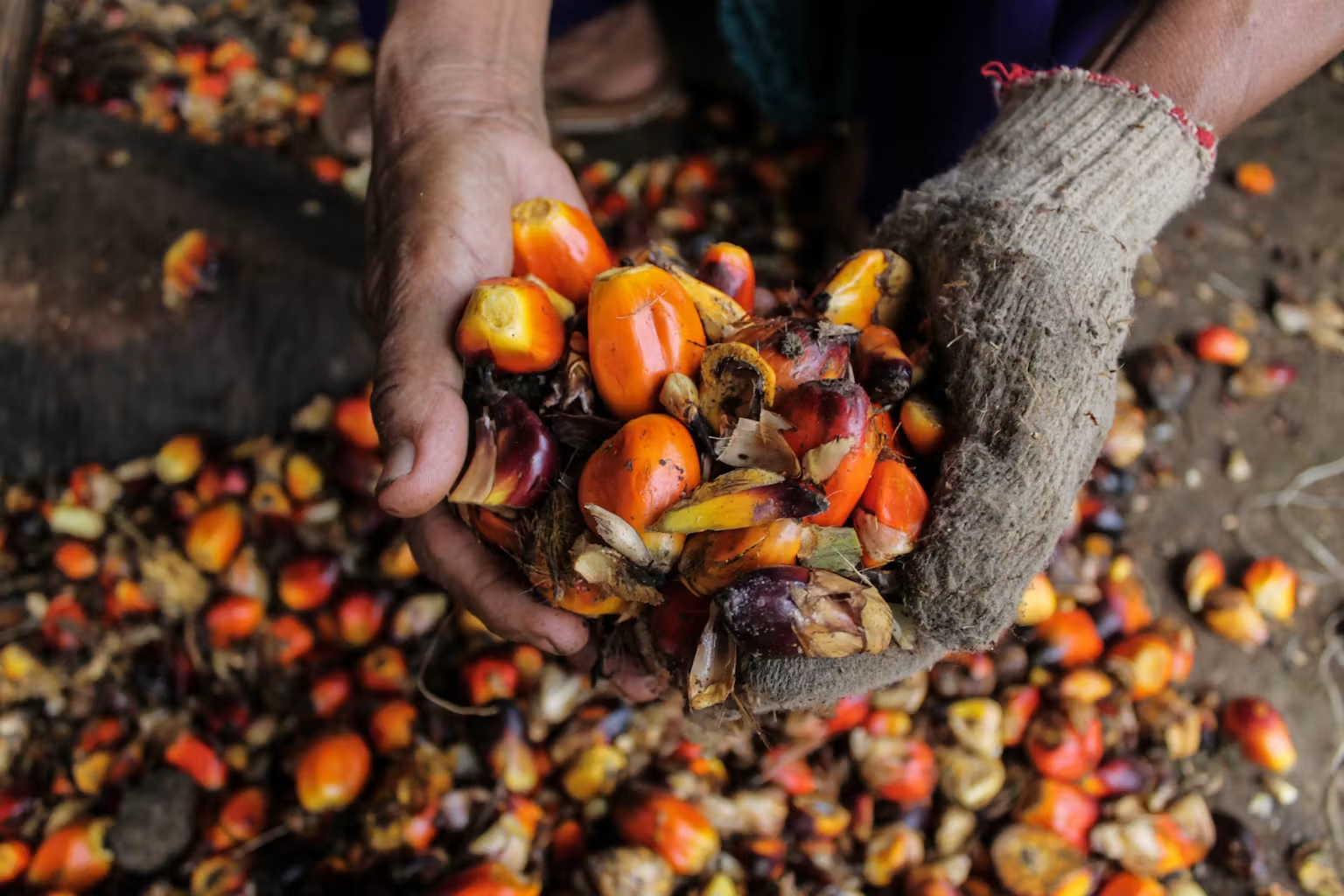
There’s a phrase making the rounds in Nigerian agricultural policy circles this year, and it isn’t subtle: “red crude.” It’s what officials in Edo State — the historic heartland of Nigeria’s palm oil industry — have taken to calling the thick, rust-colored oil pressed from palm fruit, a deliberate echo of the black crude that has defined and distorted the Nigerian economy for over half a century. The comparison is meant to provoke a question: if oil built modern Nigeria, could palm oil help rebuild it?
In April 2026, Nigeria’s Federal Ministry of Agriculture and Food Security answered that question with the most ambitious agricultural policy document the country has produced in a generation. The Oil Palm Development Policy and Strategy, covering 2026 through 2050, sets out targets that would have sounded fanciful a decade ago: capturing 10% of the global palm oil market, creating up to 2 million jobs within six years, and achieving full national self-sufficiency by mid-century. Buried in the fine print is an even bolder ambition — moving Nigeria from the world’s fifth-largest producer to its third, close enough to rival Indonesia and Malaysia, the two countries that have dominated the industry for decades.
It is, by any measure, a moonshot. Whether it’s also a realistic plan is the question worth asking.
A Fall From the Top
To understand why “red crude” carries such weight as a slogan, you have to understand how far Nigeria has actually fallen. In the early 1960s, Nigeria was the undisputed leader of the global palm oil trade, controlling something close to 40% of world supply. Then came the oil boom. As petrodollars flooded into government coffers through the 1970s, agricultural investment — irrigation, seedling research, rural infrastructure, extension services — was steadily starved of funding and attention. Farmers kept growing palm, but with aging trees, low-yield seedling varieties, and almost none of the industrial-scale replanting that transformed Malaysia and Indonesia into 21st-century agribusiness powerhouses.
The result, six decades later, is a country that still produces a respectable volume of palm oil in absolute terms — somewhere around 1.5 to 1.6 million tonnes a year — but consumes considerably more than it grows. Nigeria today imports roughly half of what it consumes, at an annual cost estimated near $600 million, even as it remains, technically, Africa’s largest producer. It’s a strange kind of leadership: dominant on a shrinking continent-sized stage, while having long since ceded the global one.
What the New Strategy Actually Proposes
The 2026-2050 policy document is notable less for any single dramatic idea than for the sheer breadth of what it tries to fix at once. Land expansion is central: industry groups, including the Oil Palm Growers Association of Nigeria and the Plantation Owners Forum of Nigeria, have pledged to expand cultivated area by 1.5 million hectares by 2029 — a scale of planting that would require years of sustained seedling supply, land clearance, and capital investment happening in parallel across multiple states.
State governments are already moving in tandem with the federal framework, in some cases ahead of it. Edo State’s Oil Palm Programme has allocated 120,000 hectares to a dozen private investors, with a target of 300,000 metric tonnes of output by 2030. Akwa Ibom State has committed roughly ₦31 billion — about $20 million — toward seedling distribution, plantation expansion, and the creation of a new state palm oil council. These aren’t just symbolic gestures; they represent real budget lines being redirected toward a crop that, until recently, received a fraction of the policy attention lavished on rice, cassava, or the oil and gas sector.
The private sector, for its part, has already shown it’s willing to put real capital behind the industry’s recovery — arguably ahead of government policy rather than because of it. Presco Plc, one of Nigeria’s two dominant listed producers, secured a $100 million investment tranche from its Belgian parent company SIAT NV in December 2025, the first installment of a promised $1 billion commitment over the next decade. That money is now flowing into new plantations in Ogun State and freshly acquired land in Cross River State. Its rival Okomu, controlled by the Luxembourg-based Socfin group, has taken a different tack, investing in yield improvement and replanting rather than new land acquisition, since it has less untapped acreage available. Newer entrants like Ellah Lakes are also angling for a piece of a domestic market estimated at close to ₦3 trillion a year, with a planned ₦155 billion investment of their own.
The Diplomacy Angle
Nigeria’s ambitions aren’t purely domestic. In a move that would have seemed unlikely even five years ago, the country has been actively working to upgrade its status with the Council of Palm Oil Producing Countries — the Indonesia and Malaysia-led bloc that functions, in miniature, something like OPEC for vegetable oil. Nigeria has held observer status since 2024, but that status is set to expire in November 2026, and the country’s Foreign Ministry has formally begun the process of converting it into full membership. The council has reportedly offered to waive Nigeria’s membership fees for two years to smooth the transition — a sign of how eager the Southeast Asian producer bloc is to bring African nations into its orbit, both to diversify its own political weight and to position itself against Western regulatory pressure, particularly the European Union’s deforestation rules.
Ghana and Colombia currently sit alongside Nigeria as observers, and CPOPC has signaled an ambition to eventually bring in Thailand, Papua New Guinea, and both of those countries as full members too, reaching a coalition that would represent something like 93% of the world’s palm oil producing nations. For Nigeria, membership would mean more than prestige — it opens doors to technical cooperation on higher-yield seedling varieties, smallholder development programs, and closer alignment with the two countries that have spent decades perfecting exactly the kind of industrial-scale cultivation Nigeria is now trying to build from a much later starting point.
The Obstacles the Policy Doesn’t Fully Answer
For all its ambition, the strategy runs directly into problems that have undercut Nigerian agricultural policy for decades, and there’s little in the document’s public framing to suggest they’ve been solved rather than acknowledged.
The most immediate is smuggling. A recent surge in cheap imported vegetable oil flowing through Nigeria’s famously porous borders has crashed local prices at the farmgate, with palm oil in some markets selling for less than ₦2,000 — a level industry figures describe as unsustainable for the smallholder farmers who still supply a meaningful share of the country’s output and depend on that income for school fees and healthcare. It’s a bitterly ironic backdrop for a national self-sufficiency push: precisely as the government commits to expanding domestic production, weak border enforcement is undermining the price incentives that would make expansion profitable for the small farmers whose participation the strategy depends on.
Currency instability compounds the problem. The naira’s volatility over the past several years has made it difficult for producers to plan multi-year capital investments with any confidence, while simultaneously making imported oil, priced in a weaker local currency against a globally-priced commodity, either punishingly expensive or, depending on the exchange rate’s swings, suddenly competitive again. Add to that Nigeria’s chronically underdeveloped rural infrastructure — roads, storage, processing facilities — and even well-funded plantation expansion risks producing fruit that can’t be efficiently milled, stored, or moved to market.
There is also the matter of institutional memory. Nigeria has announced ambitious agricultural masterplans before, several of them, with fanfare that rarely translated into multi-decade follow-through once political administrations changed. A 25-year policy horizon spanning six presidential terms and countless changes in ministerial leadership is, inherently, a bet on policy continuity that Nigeria’s post-independence history doesn’t offer much reassurance about.
The Verdict, For Now
None of this means the “red crude” ambition is empty rhetoric. The capital is real — hundreds of millions of dollars already committed by Presco, Okomu, and state governments, with more promised. The demand is real — Nigeria’s consumption gap isn’t going away, and a growing, urbanizing population will likely widen rather than narrow it without intervention. And the diplomatic repositioning toward CPOPC suggests a level of strategic seriousness that goes beyond a single ministry’s press release.
But strategy documents are cheap, and land is not. Whether Nigeria’s palm oil sector becomes a genuine national treasure, or simply the latest chapter in a long history of unrealized agricultural potential, will depend less on the ambition of the 2050 target than on whether the government can solve the unglamorous, unresolved problems sitting directly in its path: a porous border, a volatile currency, and a track record of plans that outlived neither the money nor the political will meant to carry them out.