Africa PalmOil
Inside Africa’s Informal Palm Oil Economy: The Backbone No One Talks About
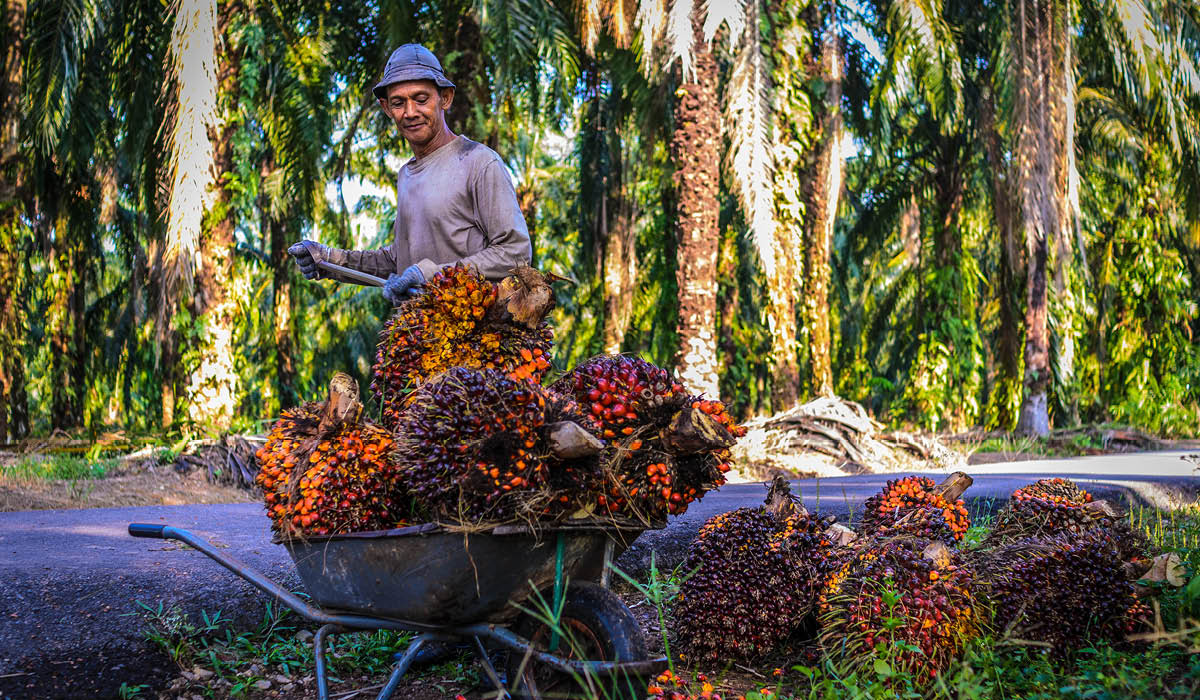
Every official statistic about Africa’s palm oil industry — production tonnages, export volumes, market-size projections — carries an invisible asterisk. Behind the tidy figures reported by government ministries and industry bodies sits a much larger, much messier economy that almost never makes it into a spreadsheet: millions of smallholder farmers, artisanal processors, and informal traders who grow, press, and sell palm oil entirely outside the reach of customs data, corporate supply chains, or agricultural censuses. In a continent where large plantation companies like Presco, Okomu, and PalmCI dominate the headlines, it’s this informal economy that quietly does much of the actual work of feeding Africa’s kitchens.
Understanding it matters, because it’s arguably the most important part of the story that official palm oil analysis tends to miss entirely.
An Economy Hidden in Plain Sight
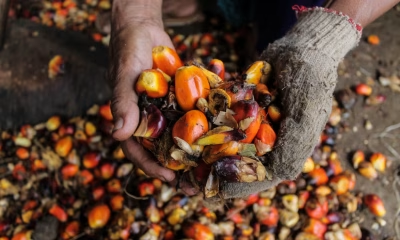
Across West and Central Africa, palm oil has never really stopped being a smallholder crop. Long before industrial plantations existed, communities across what is now Nigeria, Ghana, Côte d’Ivoire, Cameroon, and the Democratic Republic of Congo were cultivating semi-wild palm groves and pressing oil using techniques passed down for generations — hand-operated presses, communal boiling vats, sun-drying racks. Much of that traditional infrastructure is still in daily use today, running in parallel with, and often feeding into, the modern formal sector.
The scale is genuinely difficult to pin down, which is itself the point. National production statistics are typically built from a combination of estate-level reporting and rough extrapolation, meaning the actual volume moving through village markets, roadside stalls, and informal cross-border trade routes is almost certainly understated in every official figure. Agricultural economists who study the sector routinely caveat that formal statistics likely capture only a fraction of real activity — a pattern common to informal economies everywhere, but one with outsized consequences in a commodity as central to daily life as cooking oil.
Who Actually Runs This Economy
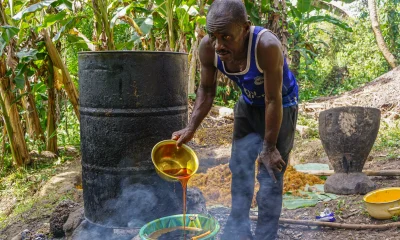
If there’s a single face of Africa’s informal palm oil trade, it’s a woman standing over a boiling vat, not a plantation executive in a boardroom. Across the palm oil belts of West Africa in particular, processing — separating oil from the fibrous fruit mesocarp through boiling, pounding, and pressing — has historically been women’s work, passed through families and cooperatives, often as the primary or sole source of household income. Traders who move the oil from village presses to urban markets are frequently women as well, running the same routes for years and building the kind of localized trust and credit relationships that formal supply chains rarely replicate.
This isn’t a minor detail — it’s arguably the defining social fact of the industry outside the plantation sector. Development agencies and gender-focused agricultural researchers have flagged for years that women’s labor sits at the foundation of the informal palm oil economy, even as the capital, land titles, and formal market access tend to concentrate elsewhere. When a large plantation company announces a new investment round or an expansion into thousands of fresh hectares, the headlines rarely mention that a parallel, far larger workforce of women processors is operating a few kilometers away, largely unbanked, uninsured, and unrepresented in the trade associations that lobby government on the industry’s behalf.
Why the Informal Sector Persists
It would be easy to assume that formal, industrial-scale plantations have simply outcompeted village-level processing and that the informal sector is a shrinking relic. The reality is closer to the opposite. In many African markets, informal production remains not just persistent but dominant, for reasons that are structural rather than nostalgic.
First, there’s the matter of land. Industrial plantations require large contiguous tracts, capital-intensive land clearance, and — in politically sensitive contexts — negotiated agreements with local communities that can take years and considerable goodwill to secure. Smallholder and semi-wild cultivation, by contrast, works with existing land-use patterns and family holdings, requiring no such consolidation.
Second, there’s the market itself. Much of Africa’s palm oil consumption happens through informal retail — open-air markets, small shops, roadside vendors — channels that formal plantation companies, oriented toward bulk industrial buyers and export contracts, are neither built nor incentivized to serve directly. The informal trader filling a jerry can at a village press and carrying it to a nearby town market is often simply a more efficient link between rural production and everyday household consumption than anything a large company’s logistics network would bother to replicate at that scale.
Third, and perhaps most overlooked, informal processing offers something industrial supply chains often can’t: immediate cash income for smallholder households, with no waiting on corporate payment cycles, quality grading disputes, or the paperwork increasingly required to sell into formal, export-oriented, or certification-conscious supply chains.
The Costs of Invisibility
None of this is to romanticize the informal sector. Its persistence carries real costs, both to the people working within it and to the wider industry’s development.
Smallholder farmers and processors operating outside formal channels are acutely exposed to the price volatility that has defined the last two years of global and regional palm oil markets. When cheap imports flood a market — as has happened repeatedly in Nigeria, where a surge in smuggled vegetable oil crashed farmgate prices to levels industry groups call unsustainable — it’s the informal-sector smallholder, without contracts, hedges, or corporate balance sheets to absorb the shock, who bears the brunt most immediately. Large plantation companies can weather a bad pricing year through diversified revenue, banking relationships, and capital reserves. A village-level processor selling into a local market generally cannot.
There are also real product-safety questions tied to informality. Without standardized processing equipment or quality oversight, informally produced and traded palm oil is more vulnerable to adulteration or contamination — a problem regulatory agencies across the region have flagged with growing concern as urban demand for cheap cooking oil has risen. The same lack of formal infrastructure that gives the informal sector its flexibility and accessibility also strips away the quality-control mechanisms that formal certification and industrial processing are designed to provide.
And critically, the informal sector is largely excluded from the very policy conversations meant to shape the industry’s future. National strategies — like Nigeria’s 25-year plan to expand cultivated area and attract foreign investment, or Côte d’Ivoire’s modernization fund for its plantation sector — are, understandably, built around measurable, formal-sector metrics: hectares planted, tonnes exported, foreign direct investment secured. Outgrower schemes, in which smallholders supply fruit to a central mill under contract, represent one of the more successful attempts to formally integrate small farmers into that structure, and models in Ghana in particular have been held up as templates worth replicating elsewhere on the continent. But outgrower schemes, by design, pull smallholders toward formal supply chains — they don’t capture or support the much larger universe of processors and traders who remain entirely outside any contracted relationship at all.
Why It Matters for the Continent’s Palm Oil Future
As foreign capital continues flowing into African plantations — from Belgian, Luxembourgish, and Singaporean agribusiness groups expanding land holdings across Nigeria, Côte d’Ivoire, Sierra Leone, and Liberia — and as governments chase increasingly ambitious production targets, there’s a real risk that policy conversations optimize entirely for the visible, formal half of the industry while leaving its larger informal foundation to fend for itself.
That would be a strategic mistake as much as an equity one. The informal sector isn’t simply a temporary inefficiency on the road to full industrialization; in much of Africa, it’s the primary mechanism through which rural households actually derive income and food security from palm cultivation, and the primary channel through which most ordinary consumers actually access the product. Any serious continental strategy for closing Africa’s palm oil supply gap — estimated in the millions of tonnes annually — will have to reckon with how to strengthen, formalize, or at minimum protect this informal backbone, rather than simply building around it and hoping the statistics eventually catch up.
The plantation boardrooms and government ministries currently steering Africa’s palm oil ambitions are, in that sense, only telling half the industry’s story. The other half is standing over a boiling vat in a village a few kilometers from the nearest paved road, doing work that keeps the continent fed while remaining almost entirely absent from the numbers used to plan its future.